
Culture & the Future
Seventeen years ago, Bitcoin was a toy for a handful of geeks; today it belongs to history. This hall gathers the art and language the movement left behind: someone inscribed a pixel skull into a Bitcoin block, someone sealed a private key inside a physical coin, someone raised a bronze statue to an inventor who never showed their face — and the argument about what comes next goes on.
On-chain art · physical art and memorabilia · memes and language · chronicle and forward-looking writings · the Open Questions Wall
The network is still producing a block roughly every ten minutes; this history is not closed. What it means remains an open question. The museum sets out the positions and makes no finding.
Art On-Chain
art native to Bitcoin and EthereumArt That Lives Entirely On-Chain
“On-chain art” is not a binary label. Ownership of an NFT is recorded by a smart contract — a program deployed on a blockchain that anyone can call. The museum sorts the works below by where the work’s data actually sits, into three tiers: Stored on-chain (the contract returns the work itself, with no external dependency) Algorithm on-chain (the generative script is held in the contract and can be re-executed independently, though the official viewing path runs through a platform server) Pointer on-chain (the contract holds only a hash or an address; the file lives off-chain and its survival depends on others). This distinction decides how long a work can last and whether it can be read from anywhere else; any visitor can re-verify the storage tier on each label by calling the contract.
Depends only on the blockchain itself
CryptoPunks · Autoglyphs
Viewed via a platform; rebuilt from the on-chain script alone
Chromie Squiggle · Fidenza
The file lives off-chain; its survival depends on others
Pak, The Merge
CryptoPunks
It turned “NFT” into a category of thing. Ten thousand 24×24 pixel avatars, given away free in June 2017, before ERC-721, Ethereum’s NFT standard, existed — it was one of the precedents the standard’s authors drew on. It has two turning points: in 2017 it established the form (ten thousand algorithmically generated avatars plus on-chain ownership) that most later avatar collections follow; in 2021 the image data itself was written on-chain, turning “a record of ownership on a chain” into “the work is on the chain”. This display focuses on the second: the work now lasts as long as the chain itself.
CryptoPunksData contract (0x16F5…F3B2). Calling punkImageSvg returns a complete 17,498-character SVG, with no server involved.punkImageSvg(index). The return value is a data:image/svg+xml string; paste it into your browser’s address bar to see the original image.Autoglyphs
It is often regarded as among the technically purest on-chain art: it references no file and points at no address — the work and the contract are the same object, and it exists for as long as Ethereum produces blocks. It is often called “the cave paintings of on-chain art”, a phrase Larva Labs’ own site uses. 512 pieces, minted out in 2019, never to be added to.
tokenURI returns 4,160 characters beginning data:text/plain;charset=utf-8, (a 64×64 grid), with no external dependencies at all.tokenURI(id). The full string it returns is the complete work and can be read as is.Chromie Squiggle
Project 0 of Art Blocks. Snowfro made it the platform’s first project: what a collector buys is not an image but a computation not yet run — the script executes at the moment of minting, and no one can know the result in advance. Its significance is that it fixed the division of labor — artist supplies the algorithm, the chain supplies the randomness, the collector triggers the generation — on which the entire generative-art NFT movement has since been built.
projectScriptByIndex(0,0) returns 5,519 characters of JavaScript. But tokenURI points to api.artblocks.io, so the image itself is rendered by the platform’s servers.Fidenza
It answers the objection generative art most often faces: where is the authorship? Tyler Hobbs’ flow-field algorithm produced 999 editions, every one different, and every one recognizably by the same hand — the consistency of style comes not from any single image but from the space of possibilities the code marks out. Set beside Squiggle, it shows how one mechanism can yield two very different authorial signatures.
tokenURI likewise points to api.artblocks.io.Pak, “The Merge”
It made ownership itself the medium of the work. The shares bought by some 30,000 collectors merge continuously into larger units; the form of the work is shaped by market behavior and has no final state at any moment. What sets it apart is that most earlier NFTs were “on-chain record plus fixed artwork”, whereas here the on-chain behavior is the work. The artist, Pak, is anonymous — itself an experiment on the art market’s cult of authorship.
tokenURI returns Base64-encoded metadata directly, and the image is an SVG generated live by the contract on-chain: each token’s circle grows or shrinks with its “mass”. Nothing depends on IPFS or on any server.tokenURI with any tool that can read Ethereum and you get each token as it looks right now. The original sales platform, Nifty Gateway, closed in February 2026; the work is unaffected. This is exactly why the museum emphasizes “storage.”Be the collector for a moment. The artist has fixed the algorithm and the blockchain supplies the randomness; the work is computed for the first time only when you press mint.
draw(hash)0x—Press “Mint one”: a new hash means a new work.
Art Native to Bitcoin
Ethereum was never the only stage for on-chain art. Bitcoin grew traditions of its own — one predating the NFT boom entirely, the other igniting the fiercest argument in the Bitcoin community in recent years.
Every sat is numbered in the order it was mined
The data is written into the transaction’s witness
Inscription: images, text and other data
attached to this one sat, and it travels with it
Bitcoin Ordinals · Inscription 0
Casey Rodarmor’s Ordinals protocol lets data such as images and text be inscribed onto individual satoshis (Bitcoin’s smallest unit; 100 million satoshis = 1 BTC), allowing Bitcoin to carry natively on-chain art and digital artifacts. The first inscription, a pixel skull, sits in block 767430. The protocol is open source.
Rare Pepes
Digital trading cards themed on the internet meme Pepe the Frog, issued through Counterparty, a token platform built on top of Bitcoin, and produced collectively by many creators, often under pseudonyms. They predate the popularity of the term NFT and are one of on-chain art’s genuinely folk origins.
Ordinals is also an open question — should Bitcoin carry art? See unit five of this hall.
Physical Art & Artifacts
when code enters the physical worldObject records
Why do people keep making physical objects out of something purely digital? The five works below each answer differently: sealing a private key into metal, raising a statue to an anonymous founder, anonymous hands spraying its symbol onto city walls, hiding a seed phrase in a street mural. They are the traces this technological movement left in the physical world.
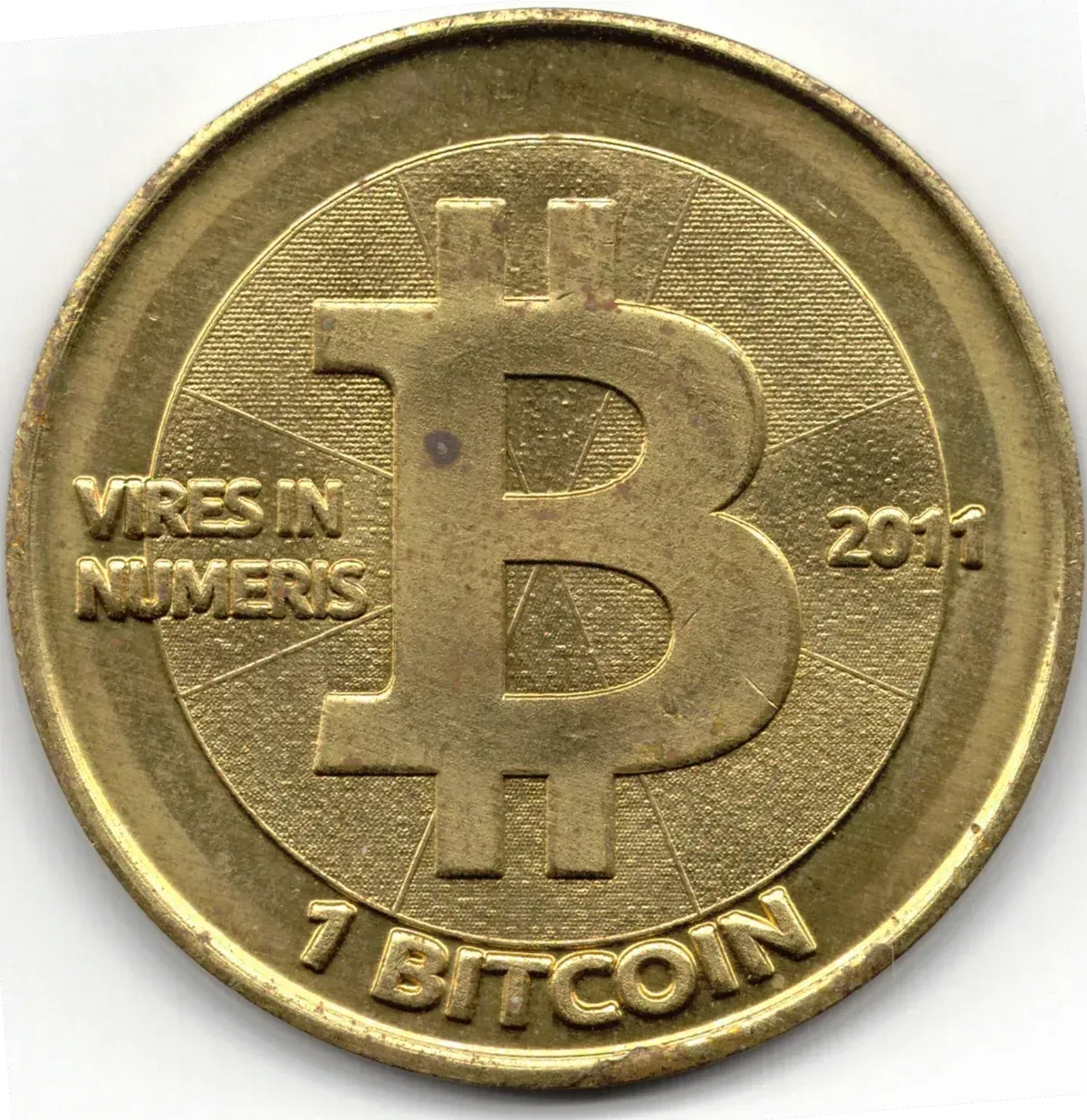
Casascius physical bitcoin
Physical commemorative coins made by Mike Caldwell, with the private key sealed beneath a tamper-evident hologram — turning the abstraction of holding back into something with weight in the hand. Production stopped under regulatory pressure, and unpeeled coins became collectors' items.

Statue of Satoshi Nakamoto, Budapest
A public sculpture designed by Réka Gergely and Tamás Gilly, whose cleverest feature is the mirrored face: anyone who approaches sees themselves in it. For a statue of an anonymous person, it may be the only honest solution.

Satoshi Nakamoto statue, Lugano
A metal sculpture by the Italian artist Valentina Picozzi, unveiled in October 2024 during the Plan ₿ Forum in Parco Ciani on Lake Lugano, Switzerland. The seated figure is built from layers of metal slats and is almost see-through; shift your angle and it seems to dissolve into the background. Read alongside Budapest’s mirrored face, it is another way of raising a statue to someone anonymous. In August 2025 the statue was torn from its base and thrown into the lake; it was later recovered.
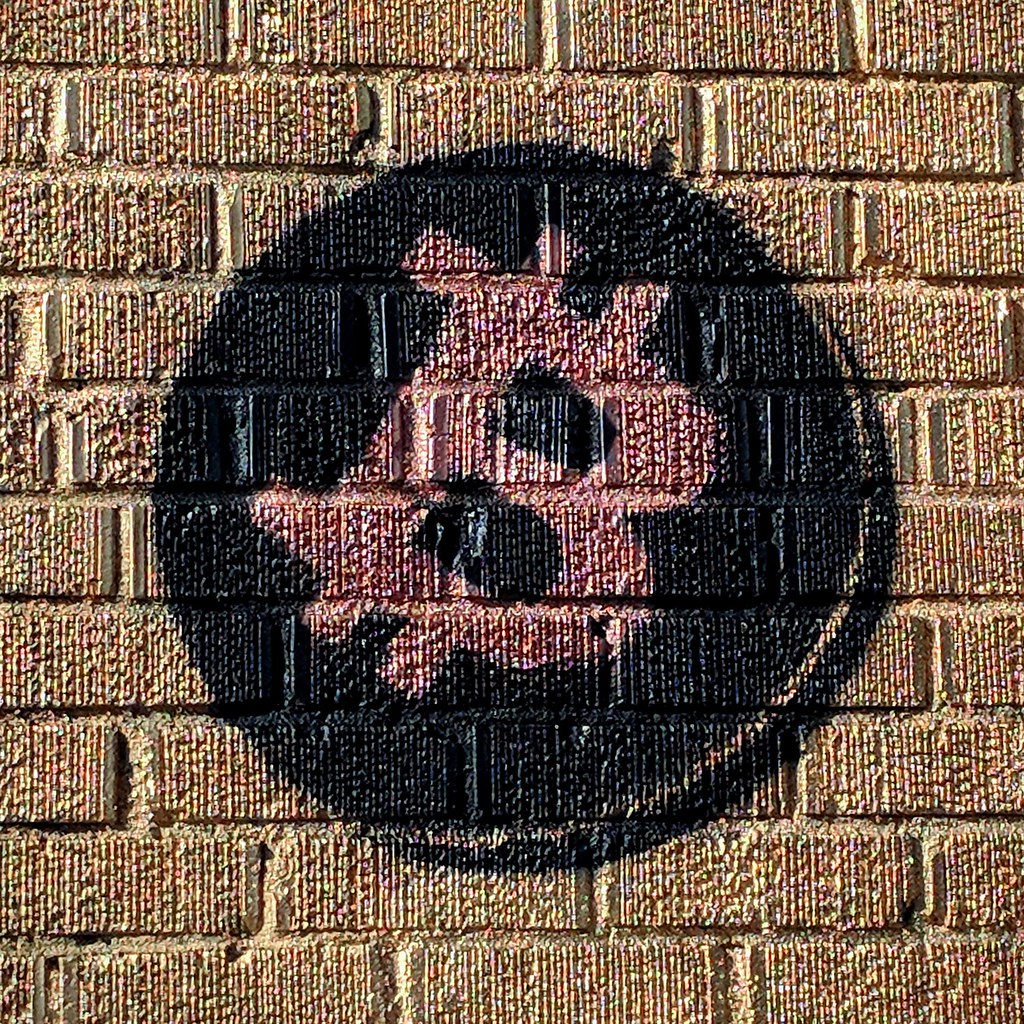
Bitcoin stencil, Deep Ellum, Dallas
A Bitcoin logo spray-painted on a brick wall in the Deep Ellum arts district of Dallas; the artist is unknown, and the photo was taken in February 2018. Bitcoin has no company and no official advertising, yet its symbol turns up on city walls, painted by people who leave no name. Street art like this is part of Bitcoin's culture.

Pascal Boyart, “Liberty Leading the People”
The French street artist PBOY repainted Delacroix’s famous canvas as a scene from the gilets jaunes protests. The project was sponsored by investor Alistair Milne, and the mural carries a QR code for Bitcoin donations. The mural also hid a Bitcoin puzzle: it was solved on January 13, 2019, and the prize (about 0.26 BTC at launch, later topped up by donations) was claimed. A direct meeting of street art and cryptography.
Shown here is Delacroix’s original painting; in 2019 Pascal Boyart used it as the basis for his bitcoin mural in Paris.
Memes & Language
research into community cultureThe Origin of HODL
On December 18, 2013, a user called GameKyuubi posted on bitcointalk meaning to write "I AM HOLDING" and typing "I AM HODLING" instead. In the post he admitted he was a terrible trader and had therefore decided to do nothing. The typo went on to become one of the best-known slogans in crypto.
The Bitcoin Sign ₿
In June 2017 Unicode 10.0 encoded BITCOIN SIGN (U+20BF), the B with two vertical strokes. The symbol came from the icon Satoshi Nakamoto designed for the Bitcoin client in 2010 and later became part of the standard, so mainstream operating systems and fonts can now render it natively.
- Code point
U+20BF- Character name
BITCOIN SIGN- Encoded in
- Unicode 10.0 · 2017-06
- Unicode block
- Currency Symbols, U+20A0–20CF
Culture & the Future
essays and outlookA Chronicle
Whitepaper published
"Bitcoin: A Peer-to-Peer Electronic Cash System" appears.
Genesis block mined
The first block is mined; the network goes live.
Bitcoin Pizza Day
10,000 BTC for 2 pizzas — May 22 becomes Bitcoin Pizza Day.
Ethereum mainnet goes live
Smart contracts arrive — the "world computer" boots up.
DeFi Summer (2020)
Decentralized finance erupts; trading and lending rebuilt on-chain.
The NFT boom
Digital ownership hits the mainstream, then cools.
El Salvador adopts it
The first country to make Bitcoin legal tender (acceptance made voluntary in 2025).
Industry winter
Terra/LUNA and FTX collapse in turn (see Triumphs & Disasters).
Spot ETF approved
US spot bitcoin ETFs are approved, putting bitcoin into ordinary brokerage accounts.
What comes next
Lightning, sovereign reserves, global payments…
By the Numbers
Foundational Essays on What Comes Next
These three essays do not describe what has happened; they ask why decentralization matters at all. They are intellectual coordinates for the movement — a good place to start if you want to understand why it arose.
Why Decentralization Matters
Chris Dixon argues that centralized platforms cooperate with developers and creators early on and inevitably turn extractive once mature — and that decentralized networks can break the cycle through credible commitments. Often cited as a defining text of the Web3 vision.
Money, blockchains, and social scalability
Nick Szabo introduces social scalability: a blockchain’s value lies not in computational efficiency, of which it has remarkably little, but in sharply reducing the trust required for strangers to cooperate. A key essay for understanding why its proponents consider the resource cost worth paying.
The promise and challenges of crypto + AI applications
Vitalik maps the opportunities and risks where blockchains meet AI — AI as participant, as interface, as the rules, as the objective, and where the safety boundary lies in each case. It weighs the opportunities and the risks with care.
Bibliography · Listed Neutrally
The books below have been enormously influential in this field, but they take positions, and some take them strongly. The museum provides bibliographic listings only — title, author and source — without excerpting, reproducing or endorsing. Readers should know these books exist, and should know they each argue a case.
The Bitcoin Standard
By Saifedean Ammous. Argues from Austrian monetary economics for Bitcoin’s standing as hard money, and is one of the most widely read works of Bitcoin economics. The book takes a strong position and is listed here for reference only. Publisher: Wiley.
The Blocksize War
By Jonathan Bier. A detailed record of the whole course of Bitcoin’s 2015–2017 scaling dispute over whether to raise the block-size limit, and an important documentary work on the split.
The Sovereign Individual
By J. D. Davidson and W. Rees-Mogg. Written eleven years before Bitcoin, predicting that digital technology would weaken the nation state and produce the "sovereign individual". Frequently cited in crypto circles for its prescience. Publisher: Simon & Schuster.
The Open Questions Wall
positions side by side, no verdictThe questions below are still being argued. For each side we choose its most representative piece and show them at equal standing, without adjudication. None of these views represents the museum’s position; if a side’s best argument is missing, please tell us using the address at the foot of the page.
Energy: Is Proof-of-Work Worth It?
This is the most persistent argument about Bitcoin, and the one most often flattened. Bitcoin keeps its ledger by proof of work (PoW): miners run specialized machines through vast numbers of calculations to win the right to add the next block, and that is where the electricity goes; by design, the same cost is what makes rewriting the ledger so expensive.
Cambridge CBECI
Maintained by the Cambridge Centre for Alternative Finance at Judge Business School, this is a widely cited source for Bitcoin’s electricity and hashrate data, updated continuously. Debates on all sides often use it as a shared reference.
ccaf.io/cbnsi/cbeciBitcoin Energy Consumption Index
Alex de Vries (Digiconomist) questions the scale of Bitcoin’s energy use and carbon footprint, argues that the environmental cost per transaction far exceeds its social utility, and has tracked electronic waste over the long term.
digiconomist.netNic Carter · energy series
Nic Carter defends proof-of-work’s energy use on both normative and factual grounds: that energy use is not in itself a moral wrong, that Bitcoin absorbs substantial curtailed and stranded energy, and that the per-transaction energy metric is methodologically ill-constructed.
niccarter.info/topicsGives “energy per transaction”, used to measure the environmental cost of each payment.
Holds that consumption tracks miner revenue rather than transaction count, and looks at where the power comes from.
We suggest reading the CBECI data first, then both sides' differing interpretations of that same data — the disagreement is rarely about the numbers, and almost always about how to price "worth it".
Regulation: Where Should the Line Fall?
EU MiCA · Regulation (EU) 2023/1114
The world’s first comprehensive crypto-asset regulatory framework, covering issuance, stablecoin reserves, service-provider authorization and market abuse. Whether or not one supports it, it has become the reference point for other jurisdictions drafting legislation.
eur-lex.europa.euOriginal: EUR-Lex · © European UnionCoin Center
A non-profit policy research organization in the United States that analyzes crypto regulation from the standpoint of civil liberties and technological neutrality, arguing for protection of open-source software and self-custody. It is the most systematic source for the side arguing to limit the reach of regulation.
coincenter.orgScaling & Ordinals: What Should a Chain Carry?
These two questions appear to be years apart, but they are the same question erupting twice: block space is scarce, so who should get it first?
The Block Size War (2015–2017)
Should blocks on the main chain simply get bigger, or should transactions move to second-layer networks built on top of Bitcoin (Layer 2)? The heart of the argument was never transactions per second but whether the cost of running a full node — a computer that keeps and checks the whole ledger itself — would rise high enough to put verification beyond ordinary people. Full documentation is in “The Block Size War” in the Triumphs & Disasters hall, and in Jonathan Bier’s book.
BIP 141 · SegWitThe Ordinals debate
Should Bitcoin carry art and digital artifacts? Supporters see it as the inevitable consequence of permissionlessness, and as fee revenue for miners. Opponents see it as crowding out block space meant for payments and raising fees for ordinary transactions. At the protocol level nobody can forbid it — which is exactly the point at issue.
ordinals.comFurther question: AI and blockchains
AI × Crypto
Is the combination of these two technologies a new paradigm or two buzzwords stacked? Trustworthy data, decentralized compute markets, identity and payments for AI agents — the opportunity and the risk arrive together. Related identity disputes, such as the argument over Worldcoin, sit here too.
Vitalik · crypto + AIKey Facts
- The cypherpunk movement (1990s) laid Bitcoin's ideological and technical groundwork.
- Bitcoin Pizza Day: May 22 each year marks the first real-world purchase.
- El Salvador became the first country to adopt Bitcoin as legal tender, in 2021.
- From a geek experiment to national law in just over a decade.